Brainwave entrainment vs binaural beats vs isochronic tones: what actually works
Brainwave entrainment covers binaural beats, isochronic tones, and audio-visual stimulation. Here is what the research actually shows about each, and how to tell a real claim from marketing.

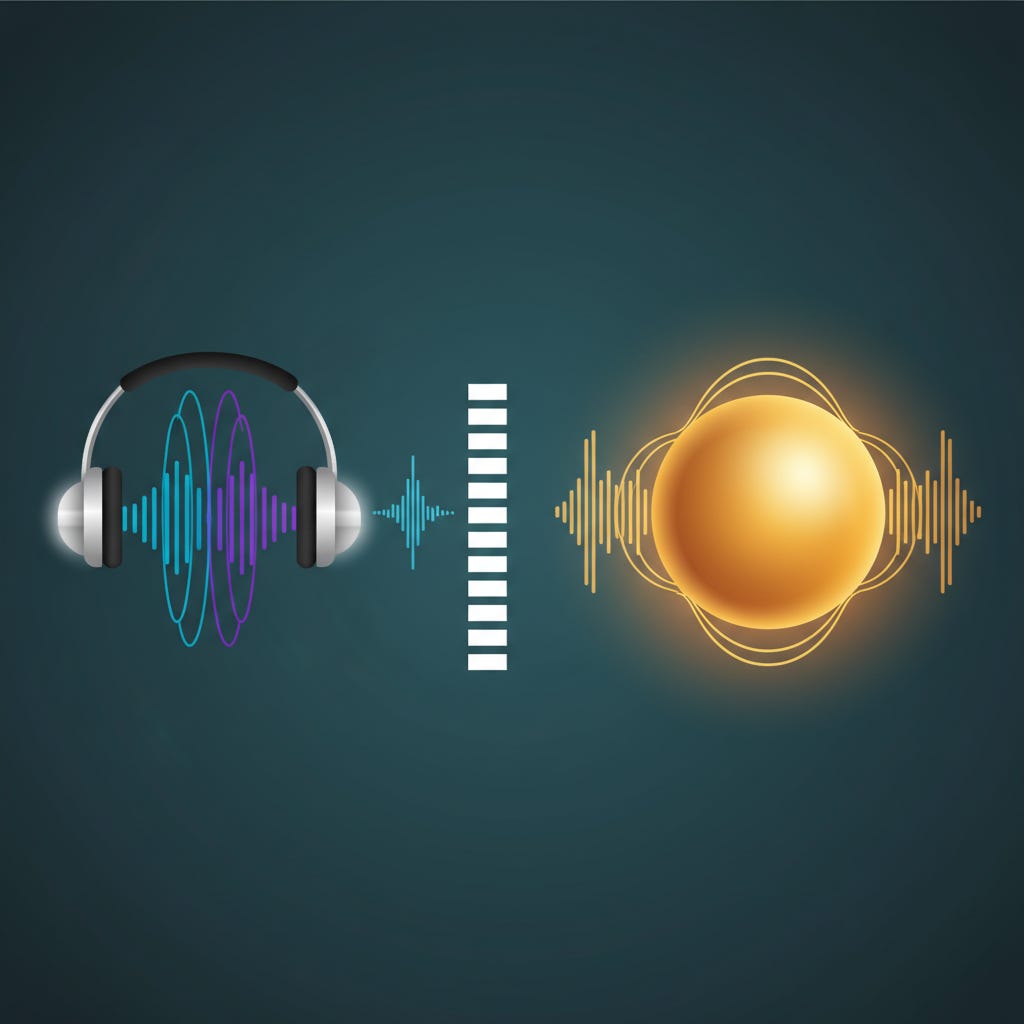
Brainwave entrainment is a general term for any method that uses a constant external rhythm made of sound or light to shift brain activity toward a specific electrical frequency. In this category isochronic tones, binaural beats, photic flicker and audio-visual entrainment (AVE) are present, but those methods are not the same in their results. It is observed that the response in the cortex is more intense when a person receives both sound and light instead of sound alone. This article explains how every method functions, what the data shows, plus how to identify product claims that are not supported by scientific research.
The frequency-following response: the foundation of the field
In 1965 scientists recorded a process which they named the frequency-following response (FFR). When a periodic stimulus enters the visual or auditory system, groups of neurons in the brainstem and cortex start to fire at that same rhythm. As shown in EEG recordings, this activity is an oscillation that matches the frequency of the input. The FFR is the physical process that allows the field of brainwave entrainment to exist, and without it, the methods described below do not have a measurable result.
To determine the strength of this response, one must look at the type of stimulus, the intensity, but also the clarity of the target rhythm. By these factors the various methods are different.
Binaural beats: how they work and where they fall short
Binaural beats function by playing two tones at frequencies that are slightly different, with one tone in each ear. As a result the brain creates a perceived third tone that is the difference between the two. As an example, if a 200 Hz tone is in one ear and a 210 Hz tone is in the other, the person hears a 10 Hz beat. With this beat the intention is to move brain activity toward a 10 Hz alpha state.
A 2016 review by Tang and colleagues examines how auditory beat stimulation relates to pain, mood and cognition studies. In those studies effects are present but are often minor and vary between different laboratories. And for this method to work, the quality of headphones must be high, both ears must have the same sensitivity, and the person must remain still. Due to the way the brain processes the beats, they do not create a high intensity cortical response on a standard EEG, and the signal is small when compared with other techniques.
Isochronic tones: the audio alternative
Isochronic tones are made of a single tone that turns on and off at a specific frequency, which is a clear rhythmic stimulus that does not rely on a perceptual illusion. Since the rhythm travels to the brain through a single channel instead of being calculated from two different inputs, many researchers say that isochronic tones are more dependable than binaural beats. If a person uses this method, they do not need equal sensitivity in both ears, and headphones are helpful but not mandatory.
On the topic of direct comparisons between isochronic tones and binaural beats, there is very little data. A 2008 review of clinical literature by Huang and Charyton looks at the psychological effects of brainwave entrainment. As stated in their review, evidence supports the use of entrainment for stress, pain and cognition, but there is no large data set that proves one audio method is better than the other.
Photic stimulation: the visual half
Photic or stroboscopic stimulation uses light pulses, usually through eyelids that are closed, at a target frequency. It is known that the visual cortex has a response to flickering light that is much larger than the response of the auditory cortex to sound. Because of this, light-based entrainment uses a broader network of neurons. At the University of Sussex, research from the Sackler Centre shows that light pulses can cause visual experiences and changes in how a person feels, even when they are healthy adults.
But there is a risk with light-based methods. For people who have a history of seizures or photosensitive epilepsy, flicker-based stimulation is not safe unless a doctor gives permission.
Audio-visual entrainment: combining both channels
Audio-visual entrainment is the use of isochronic tones plus light pulses at the same time. A 2025 review in Brain Sciences provides an update on this field. According to this report, the use of sound and light together creates a cortical response that is more consistent and more intense than the use of sound by itself. With two channels working together, the brain reaches the target frequency at a faster, but also more reliable rate.
Clinical devices like Roxiva use this method, which is also the basis for the 6th Mind app, which activates the camera flash on a phone for photic stimulation and plays isochronic audio. At the office in Sofia, practitioners provide clinical AVE services based on many sessions for depression, anxiety, insomnia and burnout. For individuals who search for a free option instead of recreational apps, the Lumenate alternative comparison explains the differences.
The honest evidence picture
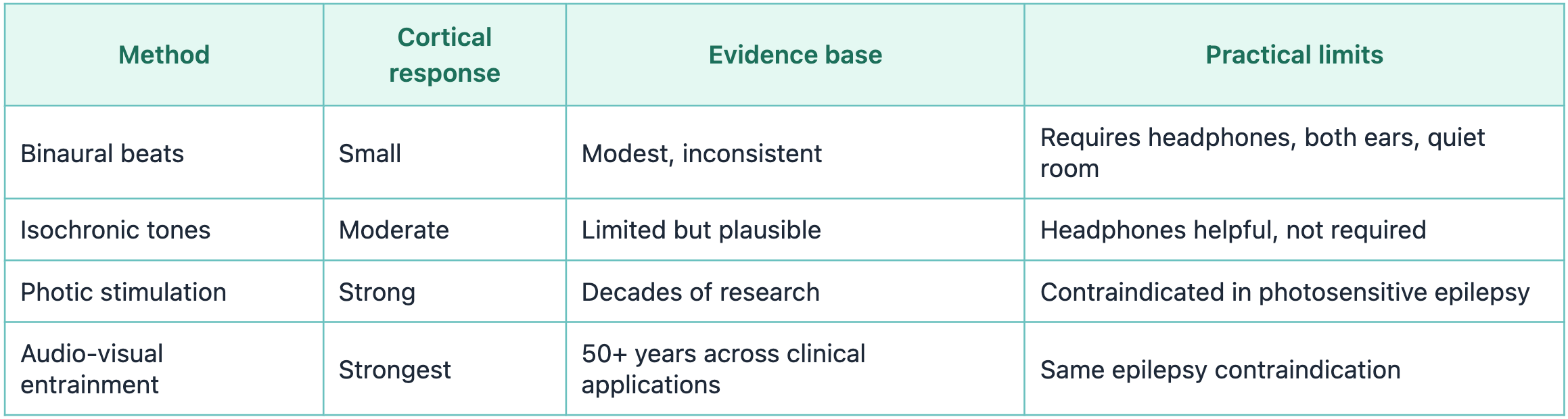
As a field this discipline exists for a long time, but researchers often use small groups of participants and different procedures. Many products for consumers also include statements that are more certain than the available data. Entrainment is a physical fact. If a product makes specific clinical claims, those are a different matter.
How to read a “brainwave entrainment” product claim
To distinguish between data and marketing, three checks are useful. First, it is important to see if the product uses only audio or audio with light. In cases where a product uses only audio, the response in the cortex is smaller regardless of the language used to sell it. Second, it is necessary to check if the company cites peer-reviewed research for its specific method, or only mentions general facts about brainwave frequencies. Third, it is vital to see if the product mentions contraindications. When a light-based product fails to warn about photosensitive epilepsy, it ignores a significant safety detail.
Brainwave entrainment is not a cure. It is a therapy that is able to support other treatments for stress, mood and sleep when the method and protocol are correct. For the practitioners at this office, the main areas of work are depression, anxiety and insomnia. There is also experience with burnout and issues related to technology. By using AVE, practitioners add one tool that has research support to a larger plan, but it is not a substitute for professional care.
Sources
“A comprehensive review of the psychological effects of brainwave entrainment” - Huang & Charyton, Alternative Therapies in Health and Medicine, 2008
“Auditory beat stimulation and its effects on cognition and mood states” - Tang et al., Frontiers in Psychiatry, 2016
“Audiovisual entrainment: a comprehensive review” - Brain Sciences, 2025
“Stroboscopic stimulation research” - Sackler Centre for Consciousness Science, University of Sussex